
REF EXERCISE
EXERCISE
Note: This subject is not mentioned in Dr. Jacob’s book. I want to emphasize here that MSM is important, but exercise is as important. And using both increases their effectiveness. MSM, a constituent of the blood increases the blood flow to the brain and fights inflammation.
It is no secret that exercise is key to a healthier and longer life. It is important that one understands that exercise of the brain is as important as exercise of the body.
Do you remember the fifth paragraph on the welcome page of this website?
Health is one’s most important asset and too many of us just waste it due to lack of knowledge.
According to the Cleveland Clinic's website, the brain benefits from physical exercise in the following ways.
Quote: Physical activity may benefit your brain in several ways, each of which, in turn, helps your brain to retain memory and optimal functioning:
Exercise may provide physical benefits to your brain itself, too. Exercise can increase the thickness of your cerebral cortex and improve the integrity of your white matter (the nerve fibers that connect areas of the brain’s nerve-cell-rich gray matter). Exercise also promotes neuroplasticity, which is your brain’s ability to form new neural connections — in other words, your ability to learn throughout your life. End of quote.
One must remember that we saw that the blood contains MSM, so the more blood goes through the brain the more MSM the brain gets.
As you must remember, MSM provides the same benefits as mentioned in this above Cleveland Clinic quote, which means that MSM and exercise could provide a double whammy to the brain. However, MSM could not replace other exercise benefits to the body and the brain.
US federal guidelines recommend at least a hundred fifty minutes of moderate aerobic activity every week. This means five days of thirty-minute workouts like brisk walking, dancing, or cycling. The guidelines also call for at least two sessions of strength training per week.
A Taiwanese study funded by the Taiwan Department of Health Clinical Trial and Research Center of Excellence and National Health Research Institutes followed 416,175 individuals for twelve years from 1996 to 2008.
The study found that fifteen minutes a day of exercise had fourteen percent reduced mortality risk and had three years longer life expectancy.
Every additional fifteen minutes reduced mortality risk by five percent.
You can see it here https://pubmed.ncbi.nlm.nih.gov/21846575/
BRAIN EXERECISE:
The following article was presented to the British Government back in 2012 and shows how exercising the brain starts as soon as you are born and has a tremendous effect on our life.
The following picture from this article shows two brains, both belonging to a three-year-old, so why is one so much bigger?
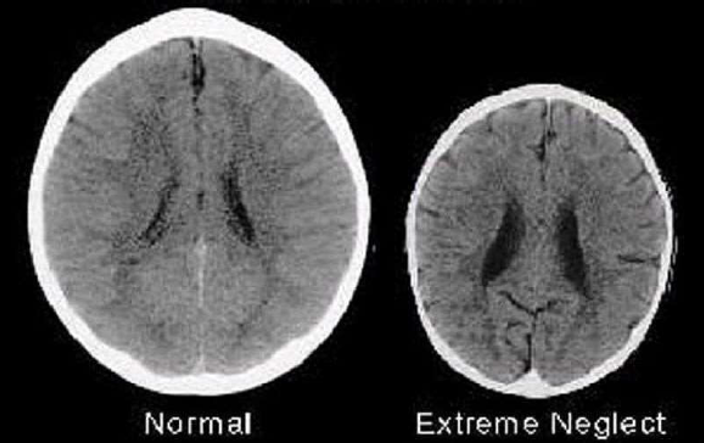
The one on the left is 51% bigger than the one on the right.
The brain on the right lacks some of the most fundamental areas present in the image on the left. Those deficits make it impossible for that child to develop capacities that the child on the left will have: the child on the right will grow into an adult who is less intelligent, less able to empathize with others, more likely to become addicted to drugs and involved in violent crime than the child on the left.
The child on the right is more likely to be unemployed and to be dependent on welfare, and to develop mental and other serious health problems.
To neurologists who study the brain, the primary cause of the extraordinary difference between the brains of these two three-year-old children is the way they were treated by their mothers.
The child with the much more fully developed brain was cherished by its mother, who was constantly and fully responsive to her baby. The child with the shriveled brain was neglected and abused. That difference in treatment explains why one child’s brain develops fully, and the other does not.
The details of how the chemical reactions that are essential to the formation of new brain cells and the connections between them are affected by the way a mother interacts with her baby and are extremely technical. Suffice it to say that there is now a very substantial body of evidence that shows that the way a baby is treated in the first two years determines whether or not the resulting adult has a fully functioning brain. The damage caused by neglect and other forms of abuse comes in degrees: the more severe the neglect, the greater the damage. Eighty per cent of brain cells that a person will ever have are manufactured during the first two years after birth. If the process of building brain cells and connections between them goes wrong, the deficits are permanent.
My opinion is:
The child on the left had his brain EXERCISED and developed in constant interaction with his mother. The one on the right was overly neglected. When a child is born after older siblings, this brain’s exercise benefits must be amplified by the interaction with the older siblings. This was not part of the report presented to the UK’s government.
And as an extension:
This is what makes a relative difference in the brain development of children who are active in extra curriculum sport and performing arts activities essential to brain development.
These extra curriculum activities are not only important for brain health and to promote a need for daily exercise, but also for learning interaction with our peers. Through these activities, the children work on focus, teamwork, control, self-discipline, fitness, coordination, and peers interaction. End of my opinion.
As mentioned in the ALZHEIMER’S DISEASE section of this website, the following shows that exercise is as important after retirement.
A study presented on July 2, 2022, at the Alzheimer’s Association International Conference in San Diego, California shows that, just four days a week of regular stretching and motion exercises can help older people with cognitive decline, the precursor of Alzheimer's disease, and stop the progress of their cognitive decline. Also noted by the study's author that having a social group, or a network of support was crucial for the elder participants.
Per Maria Carrillo, Ph.D., the chief scientist at the Alzheimer's Association, research in the past has indicated that daily physical activity has helped reduce inflammation in the brain and increase the amount of blood flowing to it.
As one can see, the importance of exercise for one’s body and brain during one’s whole lifespan is certainly not emphasized enough in our education. Especially for young family starters and for elderly people.
Here are examples of people who understand the importance of exercise for the body and the brain.
1.- At ninety-four years old, actress Terry Moore, who has been acting for eighty-four years, in an April 21, 2023, People’s magazine interview about her recent film said:
(a) "I have worked longer than anybody else." I feel great, my health is wonderful, (b) I love to watch movies, (c) exercise, and (d) read.
She gets exercise of the body in (c) and of the brain in (a, b, and d).
However, for a long life, the most important thing is she does what she likes.
2.- At one hundred years old, neurologist Dr. Howard Tucker, M.D. has been practicing for more than seventy-five years and is the world’s oldest practicing doctor. Here is what he says:
a) I do not spend my days retired.
If you are blessed to have a career you enjoy and are still able to work, consider delaying retirement. Many people who retire and become inactive in their day-to-day routine are at an increased risk of cognitive decline.
b) I do not let myself get out of shape.
Swimming, jogging, hiking, and skiing well into my late-80s has kept me strong and healthy. I try to get in at least three miles on my treadmill at a brisk pace most days of the week.
c) I do not smoke.
When I was in high school in the 1930s, I told my father that I wanted to take up smoking. He said, “That is all right with me. But why would anyone want to put anything but fresh air into his lungs when life is so short as it is?”
That immediately took the fun and excitement out of tobacco for me.
d) I do not restrict myself.
Moderation allows us to live life to the fullest while also keeping us from going overboard and impacting our health in the long run.
We have salad with every meal, and enjoy greens like bok choy, broccoli, and Brussels sprouts. I wonder if he knows that these are some of the most sulfur rich foods.
The real secret to longevity is that there are no secrets. But we live daily and die once, so we must make the most of the time we have.
e) I do not let my knowledge go to waste.
He enjoys teaching medical students his experiences. It also allows him to participate in a group activity.
His wife of sixty-five years Sara also still practices psychoanalysis and psychiatry at age eighty-nine.
What we see here is the recipe for aging well, do what you enjoy with moderation in all with exercise of the body and the brain.
3.- At one-hundred-and-nine years old, Vincent Dransfield, a retired auto parts manager who retired in his late seventies because of his wife telling him it was time for him to quit. He still drives his car around town.
From the age of twenty-one, he spent more than forty years as a volunteer at the local fire department where he still goes from three to five every day to talk with the members.
When asked what brought him happiness and kept him going in life, he quickly answers: “The fire department. … I met so many friends.”
As we see in ALZHEIMER’S DISEASE, having a social group, or a network of support is crucial for the elderly.
He left school at fifteen and went to work on a dairy farm and delivered milk for five years and has been drinking a lot of milk since then. He attributes his longevity to the milk he drinks, which makes a little sense as cow milk is the food that contains the most MSM.
He never exercised in itself but was so active that he did not need to. For forty years, he ran out to answer the fire alarms.
Structured exercise amuses him. “He laughs at people who jog. He is like, ‘Where are they running to?”
He eats all what he likes and drinks a beer once in a while.
He started smoking at fifty and stopped at seventy saying it was never too late to fix a bad habit.
As we see, this man does what he likes, all in moderation, and keeps his body and mind busy all the time even if he does not do exercise per say.
I REALLY BELIEVE THESE THREE EXAMPLES SHOW WHAT IS THE RECIPE FOR AGING WELL, DO WHAT YOU LOVE TO DO, KEEP YOUR BRAIN AND BODY EXERCISING, HAVE A BALANCED DIET WITH EVERYTHING IN MODERATION.
PLEASE CLOSE THIS BROWSER WINDOW TO BE BACK TO WHERE YOU WERE BEFORE COMING HERE.